Piano Great Overcomes His Mysterious Illness
(Profile of pianist Keith Jarrett)
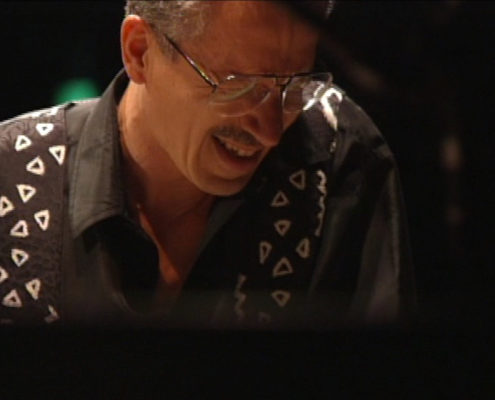
Keith Jarrett in performance.
The National Post, 20 November 1999
By Stewart Hoffman
Though Keith Jarrett has performed thousands of concerts during his 35 years as one of the most influential pianists in jazz, stepping onto the stage of Roy Thomson Hall tomorrow evening will not be an act he takes for granted.
For a long while after the mysterious illness known as Chronic Fatigue Syndrome (CFS) first laid waste to his system during a fall ’96 tour of Italy, Jarrett didn’t know if he would ever perform again. He was virtually housebound for two years, struggling with the stultifying fatigue – chief among several symptoms he didn’t particularly want to discuss – and the dizziness that still prevents him from reading music.
At one point he put on a video of his Tokyo ’96 concert. It must have seemed like an out of body experience as he saw a Keith Jarrett at the height of his creative powers, a pianist who could barely contain the rushes of energy coursing through his body that literally lifted him to his feet and pitched his head back and forth to the music.
“I sat there on the sofa like a vegetable,” said Jarrett, speaking from his rural New Jersey home, “and I was watching myself play and I thought ‘This isn’t going to happen again unless I’m really lucky.'”
Not much is known about CFS, and once you’re diagnosed with it, says Jarrett, no one knows what to do about it. So about two-and-a-half years ago, he embarked on an experimental treatment.
“I got in on a program that was aggressive and medically based and scary to a lot of other patients because it involves antibiotics for a long period of time,” he says. “I’ve known people who have had the disease for 25 years who haven’t tried this method.”
The intensive treatment seems well suited to Jarrett, who is fond of an old Bulgarian proverb: If you wish to drown, don’t torture yourself with shallow water.
Shallow is not a word you would ever associate with Jarrett.
If he were only known as an inspired improviser and an innovator on his instrument, his place alongside Art Tatum, Thelonious Monk, Bill Evans and a handful of other jazz pianists would be secure. But his achievements as a classical pianist – not a crossover dabbler but a true artist who provides genuine insight in performance – are also formidable.
He has performed classical recitals at Lincoln Center, The Kennedy Centre, and at Bonn’s Beethovenhaus, and has recorded Bach’s Goldberg Variations on harpsichord, as well as a number of Mozart piano concertos, among other works. His release of Shostakovich’s 24 Preludes and Fugues was selected Classical Recording of 1992 by CD Review.
Jarrett, 54, began studying classical piano in his hometown of Allentown, Pa., his prodigious talent leading to recitals at the Academy of Music in Philadelphia and Madison Square Garden. It wasn’t until he was in his teens that he started playing jazz, turning down an opportunity to study with Nadia Boulanger, one of the most renowned pedagogues of the century, to study jazz at Boston’s Berklee School of Music.
He went on to New York, eventually playing with the Charles Lloyd Quartet, a group that was a jazz phenomenon in the ’60s, sharing bills with the likes of Janis Joplin and Jefferson Airplane, and packing them in at San Francisco’s rock palace, Fillmore West. He joined Miles Davis’ band for two years before heading out to lead his own groups, the most famous of which is the Standards Trio, appearing in Toronto tomorrow night.
Born out of a 1983 recording session with bassist Gary Peacock and drummer Jack DeJohnette – jazz legends in their own right – the trio derived its name from the music it draws from, the “great American songbook” of the 1930s, ’40s and ’50s. But to this day the band doesn’t rehearse, there are no arrangements, and no one, including Jarrett, knows what they’re going to play until they’re onstage. It’s essentially a jam session, with all the spontaneity that that implies, and the combination of invention, subtle communication and joyous, swinging abandon among kindred spirits has made it, simply, the most celebrated jazz ensemble of the decade.
But parallel to his work with the Trio were the series of extraordinary solo piano concerts that Jarrett began in the early ’70s and continued to perform until 1996: improvisations, often epic in scope, such as the first part of his 1995 concert at La Scala. A 45 minute tour de force running the gamut of emotions and musical techniques, it – like all the other solo efforts – is constructed upon nothing more than the inspiration summoned at the moment of performance, without the terra firma of a melody or set of chord changes to fall back on. Jarrett is sure that it was the stress of performances such as this that contributed to his illness. As he told the LA Times, “I think there is an essential insanity – physical and emotional insanity – to the solo thing. In the way I approach my work, I was asking for it.”
But if solo marathons such as these contributed to Jarrett’s illness, then there is some justice in the fact that his weakened state provided the context for a very different musical endeavour.
In December, 1997, Jarrett walked into the small recording studio next to his house, set up microphones around his newly refurbished Hamburg Steinway and, working a half-hour at a time to conserve his energy, recorded a Christmas present for his wife, Rose Anne. Just released on CD, The Melody at Night, With You is unlike any other solo recording Jarrett has produced. There is almost no improvisation on the disc; the standards and traditional songs played are stripped to their essence. It is melody at its most haunting, with a core emotional thread of wistful, magical reflection. Jarrett refers to the CD as his treasure. “There was this illness,” he says, “and the illness was vast, and somehow I was able to make it talk.”
Things have been looking up for Jarrett since then. He played his first comeback concert with the Trio last November, and has played a few, very carefully scheduled concerts since then. And while his health is still not one-hundred percent, the glowing reviews suggest that his playing has not diminished one iota.
When the Standards Trio comes to town, it’s always a major musical event. Seeing Keith Jarrett back on stage and in control brings to this particular event the added dimension of celebration.
(Profile of pianist Keith Jarrett)