Take Note
(The “Mozart effect” and early childhood music education)
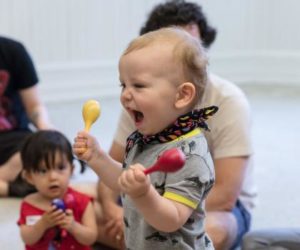
An early childhood education class at Toronto’s Royal Conservatory of Music.
Homemaker’s magazine, May 1999
By Stewart Hoffman
It’s early Saturday morning at the Hugh Mappin Children’s Learning Centre at Toronto’s Royal Conservatory of Music, and the strollers are lined up along the hallways like taxis at an airport. Inside one of the classrooms, parents walk, gallop and tiptoe to a variety of music, holding their babies in their arms so they can feel the rhythm. Over the next half hour they sing nursery rhymes, bounce their children on their knees, play finger- and toe-tickling games. They even rattle homemade shakers and rhythm sticks.
All of these parents are probably familiar with the widely known benefits of childhood music education: that it enhances motor skills, social skills, creativity and, lest we forget, that it gives pleasure. What they may not know is that the early study of music could play a significant role in the development of their child’s brain.
Experiments by Dr. Frances Rauscher and physicist Gordon Shaw at the University of California, Irvine, link the study of music to increased spacial intelligence — the ability to manipulate mental images of physical objects and perform the kind of mental gymnastics so important to geometry or physics, engineering or architecture. When undergraduates at the university listened to Mozart as a prelude to a spatial IQ test, they scored higher than students who went in cold. Although this “Mozart effect” lasted only 10 minutes, a more recent experiment, published in the February ’97 issue of Neurological Research, showed that pre-schoolers who studied piano scored 34 per cent higher in spatial-temporal reasoning tests. “Music lessons,” concludes Rauscher, “seem to promote the neural development required for spatial-temporal reasoning.” In other words, studying music early on might permanently wire the brain for success in math and science. But how early is too early?
“Singing to your baby before its born is one way to start,” says Katherine Smithrim, a professor in the faculty of education at Queen’s University in Kingston, Ont., and the first to introduce music and baby classes in Toronto in the early 1980s. “Children recognize the songs that were sung to them in the womb.” It may be the ultimate surround-sound experience. And singing to your child — both pre- and post-birth — helps develop a “disposition” to music that can’t be taught.
Once children reach the advanced age of three, there’s a much broader — sometimes bewilderingly so — musical landscape from which to choose. Music schools and conservatories, community centres and local Y’s offer a variety of music education classes: eurythmics classes, with a focus on movement; Kodaly classes, which are vocally based; and Orff classes, which incorporate the playing of percussion instruments (a collection of user-friendly xylophones, metallophones, shakers and drums) to accompany singing and movement. Or parents may prefer a generic “music for your child” class that incorporates elements of all three. What all of the classes have in common is the fundamental belief than anyone can learn music, and that children can learn it as naturally as they absorb the nuances of their native tongues.
It shouldn’t take parents long to decide if a childhood music education class is effective, says Wendy Taxis, a eurythmics teacher at the Royal Conservatory of Music. “Kids start singing and moving around.” As Taxis plays “Twinkle, Twinkle Little Star” on the piano, her class of four-year-olds begin gliding around the room, illustrating her point. Arms stretched high above their heads, they transform themselves into stars, fingers opening and closing — twinkling. When the music descends to a lower register, the children respond, becoming starfish, lying on the floor, submerged in the ocean. As the children develop, says Taxi, the activities will demand greater concentration and quicker response. “And in three months their listening skills will be much more acute.”
For parents who want to give their children a jump start on the study of an instrument, Suzuki classes, which teach kids the violin, piano, viola and cello (and to a lesser extent the flute and guitar) as early as age three, may be the answer. Shinichi Suzuki also believed that children could learn music as naturally as they learn a language; thus, they’re provided with music tapes to take home, listen to and imitate. The reading of music, as with a language, comes later. Parental involvement is key; parents are expected to work with the children at home, and be present for both private and group lessons. “Suzuki emphasizes the family environment — what the child listens to at home, the interrelationship between parents and children, and what values there are in terms of music,” says Margot Jewell, director of the Etobicoke Suzuki School in Toronto. “He believed that we need to surround our children with music in the home, and that the parent needs to be a partner with the teacher.”
If the Suzuki method seems like a far cry from your childhood experience with the neighborhood piano teacher, it probably is. But that doesn’t mean that going to a private teacher can’t be the springboard to a lifetime of musical involvement and enjoyment. The key is finding the right instructor. Margaret Halliwell is a Royal Conservatory of Music piano teacher who is renowned for her work with children. “The personality of the teacher plays a huge role,” she says. “A good teacher has to be nurturing if the child is going to continue.” Nurturing, well-trained and musical. Halliwell recommends getting recommendations from friends or calling a reputable school or conservatory or a university music faculty. And don’t be afraid to ask for credentials. Those first music lessons will have a tremendous impact on your child’s musical life.
Cynthia Dan Beardsley, chair of the Toronto Coalition for Music Education, says we should heed the lessons learned in California, when the state eliminated their music programs in order to cut costs. “Kids started performing lower on tests, and as much as you don’t want to say this is all about test scores, it proves what many of us have known all along.”
Music matters.
(The “Mozart effect” and early childhood music education)